Generative Engine Optimization for Small Business: What Works and What Is Hype
What GEO is, what Google, OpenAI, Anthropic and Perplexity document about crawlers, and five steps a small business can take, with sources.
Generative engine optimization (GEO) means making your business easy for AI answer tools such as Google's AI Overviews and AI Mode, ChatGPT, Claude and Perplexity to find, understand and cite. Google's own guide says optimizing for these features is "still SEO," and OpenAI, Anthropic and Perplexity each publish bots, most of which you can allow or block in robots.txt. For a small business that comes down to four jobs: let the right bots in, publish pages that answer real customer questions, keep your business details consistent, and check every month what the tools say, because nobody can promise that an AI tool will mention you.
Updated October 29, 2026.
What is generative engine optimization (GEO)?
GEO is a label for improving how often AI-generated answers include and cite your content. It comes from a 2023 research paper, "GEO: Generative Engine Optimization" (Aggarwal and five co-authors, KDD 2024). The authors report that GEO "can boost visibility by up to 40% in generative engine responses," with results that vary by domain. That is a result from their own benchmark, not a forecast for your business.
Google is blunter. In its guide "Optimizing your website for generative AI features on Google Search" (last updated July 10, 2026), it writes: "From Google Search's perspective, optimizing for generative AI search is optimizing for the search experience, and thus still SEO."
In my view: treat GEO as a to-do list on top of good SEO, not as a separate service. If someone sells it as a mystery, ask which line of Google's, OpenAI's, Anthropic's or Perplexity's documentation it is based on.
How does Google decide what shows up in AI Overviews and AI Mode?
Google says there are no additional technical requirements. A page must be "indexed and eligible to be shown in Google Search with a snippet" to appear in its generative AI features. Google's AI features page says AI Overviews and AI Mode "may use" a technique it calls query fan-out, "issuing multiple related searches across subtopics and data sources," which lets them show "a wider and more diverse set of helpful links." Traffic from these features is counted in Search Console's overall search traffic, under the "Web" search type.
Google also spells out what you do not need:
- "You don't need to create new machine readable files, AI text files, markup, or Markdown to appear in Google Search (including its generative AI capabilities), as Google Search itself doesn't use them."
- "There's no requirement to break your content into tiny pieces for AI to better understand it."
- "Structured data isn't required for generative AI search, and there's no special schema.org markup you need to add."
Which AI crawlers should a small business allow or block?
Each company runs separate bots for search, for training and for actions a user requests. OpenAI says "Each setting is independent of the others": for example, you can allow OAI-SearchBot to appear in search while disallowing GPTBot.
| Bot | What the company says it does | What to know about robots.txt |
|---|---|---|
| OAI-SearchBot (OpenAI) | Surfaces websites in ChatGPT search | Opted-out sites are not shown in ChatGPT search answers, though they can still appear as navigational links |
| GPTBot (OpenAI) | Makes its foundation models more useful and safe | Disallowing it signals no use for training |
| ChatGPT-User (OpenAI) | Certain user actions in ChatGPT and Custom GPTs | Rules "may not apply" |
| Claude-SearchBot (Anthropic) | Improves search result quality | Blocking prevents indexing for search |
| Claude-User (Anthropic) | Accesses sites when a user asks Claude | Blocking prevents retrieval for that query |
| ClaudeBot (Anthropic) | Collects web content for its models | Blocking excludes future material from training |
| PerplexityBot (Perplexity) | Surfaces and links sites; not used for training | Perplexity recommends allowing it |
| Perplexity-User (Perplexity) | Visits a page when a user asks | Generally ignores robots.txt |
| Googlebot (Google) | Google Search, including AI features | Google lists nosnippet, data-nosnippet, max-snippet and noindex to limit what is shown |
A starting robots.txt that lets the search bots in:
User-agent: OAI-SearchBot
Allow: /

User-agent: Claude-SearchBot
Allow: /

User-agent: PerplexityBot
Allow: /
Whether to allow the training bots (GPTBot, ClaudeBot) is your decision and does not change the search settings. For search results, OpenAI says it can take about 24 hours after a robots.txt update for its systems to adjust. OpenAI, Anthropic and Perplexity each publish IP ranges for their bots, which your web host can use if a security setting is blocking them. Allowing a bot lets it read your pages; none of the documents cited here promises that it will cite you.
What can a small business do, step by step?
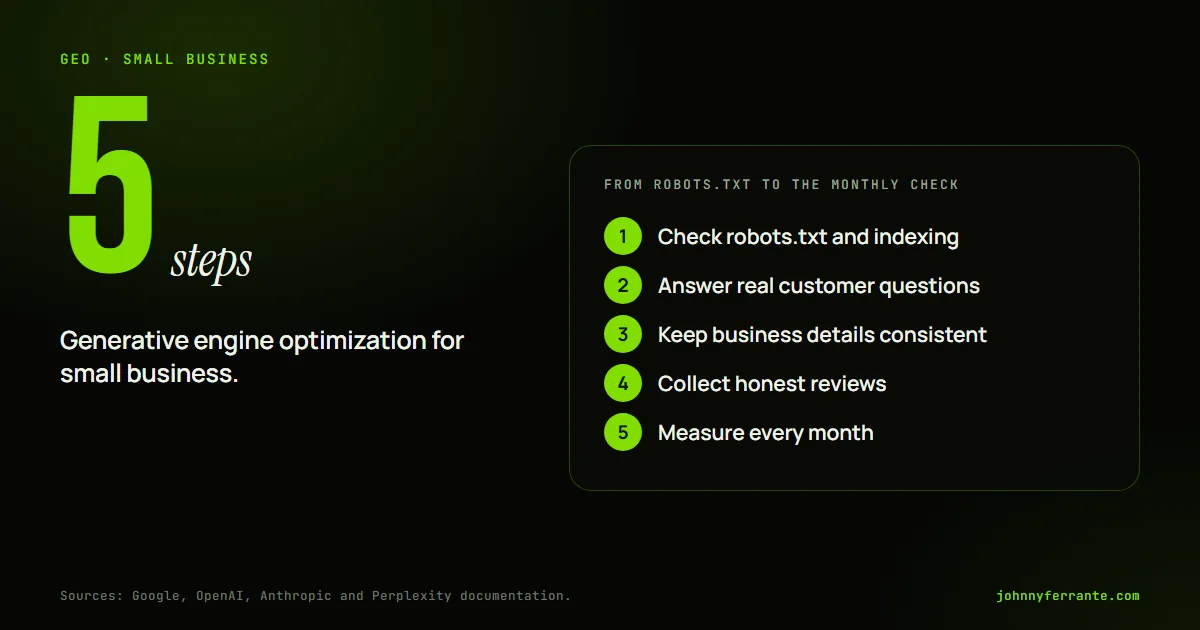
- Check robots.txt and indexing. Open yourdomain.com/robots.txt and make sure no rule or security setting blocks the search bots above. Then confirm your key pages are indexed, which is Google's condition for its AI features.
- Answer real customer questions on your own pages. Google separates "commodity content," such as "7 Tips for First-Time Homebuyers," from "non-commodity content," such as "Why We Waived the Inspection & Saved Money," which it says "provides unique expert or experienced takes that go beyond common knowledge." Write from what you actually do: your process, your service area, the questions customers ask every week.
- Keep your business details consistent. Google says a Business Profile name should "reflect your business's real-world name, as used consistently on your storefront, website, stationery, and as known to customers." P.O. boxes, remote mailboxes and virtual offices do not qualify, and service-area businesses should hide their address. Google's guide adds that Merchant Center and Business Profiles "can help your products and services to be visible in both AI responses and other Google Search results." In my view: use the same name, address and phone number on your site, your profile and every directory.
- Collect honest reviews. Google's review policy prohibits offering incentives such as payment, discounts or free goods and services in exchange for a review, and bans content that is not based on a real experience.
- Measure every month. Ask ChatGPT, Claude, Perplexity and Google the same five questions a customer would ask. Log who is named and which sources appear, and watch the trend, because answers change. Check Search Console, and if you can see server logs, look for the bot names in the table.
Is llms.txt worth it?
Not as a way to get cited. llms.txt is a proposal by Jeremy Howard, published September 3, 2024 at llmstxt.org, to use "an /llms.txt file to provide information to help agents use a website." The site says AI labs publish llms.txt files for their own developer docs (OpenAI, Anthropic and Gemini). In my view, that is not the same as their search products reading yours.
Google's position is clear. Its guide says you don't need "machine readable files, AI text files, markup, or Markdown" to appear in Google Search, "as Google Search itself doesn't use them." On June 2, 2026, Search Engine Journal reported that Google's John Mueller, replying on Reddit, called llms.txt "purely speculative for now" and said the file "has existed for years, yet none of the AI systems use it."
In my view, publishing one is a cheap experiment. Do not pay for it and do not expect citations from it.
What else is hype?
- Promised placement. No document cited here offers a way to buy a spot in organic AI answers. OpenAI's crawler page does list OAI-AdsBot, which "is used to validate the safety of web pages submitted as ads on ChatGPT," so paid ads exist there; this guide covers organic visibility only.
- Special AI markup or rewrites. Google says no special schema.org markup is needed and that content does not have to be broken into tiny pieces.
- Fake or incentivized reviews. Google's policy prohibits them.
Frequently asked questions
Is GEO different from SEO?
Google says no: optimizing for generative AI search "is optimizing for the search experience, and thus still SEO." The extra work is checking that the AI companies' bots can reach your site and measuring what the tools say about you.
If I block GPTBot, will I disappear from ChatGPT?
Not necessarily. OpenAI says each setting is independent: you can allow OAI-SearchBot to appear in ChatGPT search and disallow GPTBot, which concerns training. Sites that opt out of OAI-SearchBot "will not be shown in ChatGPT search answers," though they can still appear as navigational links.
Do I need schema markup to appear in AI Overviews?
No. Google says structured data isn't required for generative AI search and no special schema.org markup is needed.
How long until changes show up?
For search results, OpenAI says it can take about 24 hours after a robots.txt update for its systems to adjust. None of the documents cited here gives a timeline for appearing in AI answers, so measure monthly instead of daily.
Do I need a Google Business Profile?
Google says Business Profiles can help your products and services be visible in AI responses and other results. To create one, your business must either have "a physical location that customers can visit, or travels to customers where they are."
Who is writing this
Johnny Ferrante, founder of Quimera Group (Bolivia) and Tech Agents (Miami), and one of the five speakers at the SKÅL International Tourism Forum 2026 in Cochabamba. More at johnnyferrante.com/prensa. A related guide in Spanish: Cómo preparar tu negocio para que ChatGPT, Claude y Google puedan encontrarlo.
To see how your business shows up in these tools today, request the 20-minute Diagnostic: you tell me where you are and you leave knowing which system you need and what you should not buy.
Sources (checked October 29, 2026)
- OpenAI, crawlers (OAI-SearchBot, GPTBot, ChatGPT-User, OAI-AdsBot): developers.openai.com
- Anthropic, crawlers (ClaudeBot, Claude-User, Claude-SearchBot): support.claude.com
- Perplexity, crawlers (PerplexityBot, Perplexity-User): docs.perplexity.ai
- Google, AI features in Search (last updated December 10, 2025): developers.google.com
- Google, "Optimizing your website for generative AI features on Google Search" (last updated July 10, 2026): developers.google.com
- Google, Business Profile guidelines: support.google.com
- Google, Business Profile review policy: support.google.com
- Aggarwal et al., "GEO: Generative Engine Optimization" (KDD 2024): arxiv.org
- llmstxt.org, the llms.txt proposal: llmstxt.org
- Search Engine Journal, "Google says llms.txt is purely speculative for now" (June 2, 2026): searchenginejournal.com
Want this running in your business?
See how we work, or join the community for free and ask about whatever is holding you back.
In this guide
- What is generative engine optimization (GEO)?
- How does Google decide what shows up in AI Overviews and AI Mode?
- Which AI crawlers should a small business allow or block?
- What can a small business do, step by step?
- Is llms.txt worth it?
- What else is hype?
- Frequently asked questions
- Is GEO different from SEO?
- If I block GPTBot, will I disappear from ChatGPT?
- Do I need schema markup to appear in AI Overviews?
- How long until changes show up?
- Do I need a Google Business Profile?
- Who is writing this
- Sources (checked October 29, 2026)