How to Choose an AI Consultant in Miami, Florida (2026)
How to choose an AI consultant in Miami, Florida: questions to ask, red flags, deliverables to demand, and what you should own when the project ends.
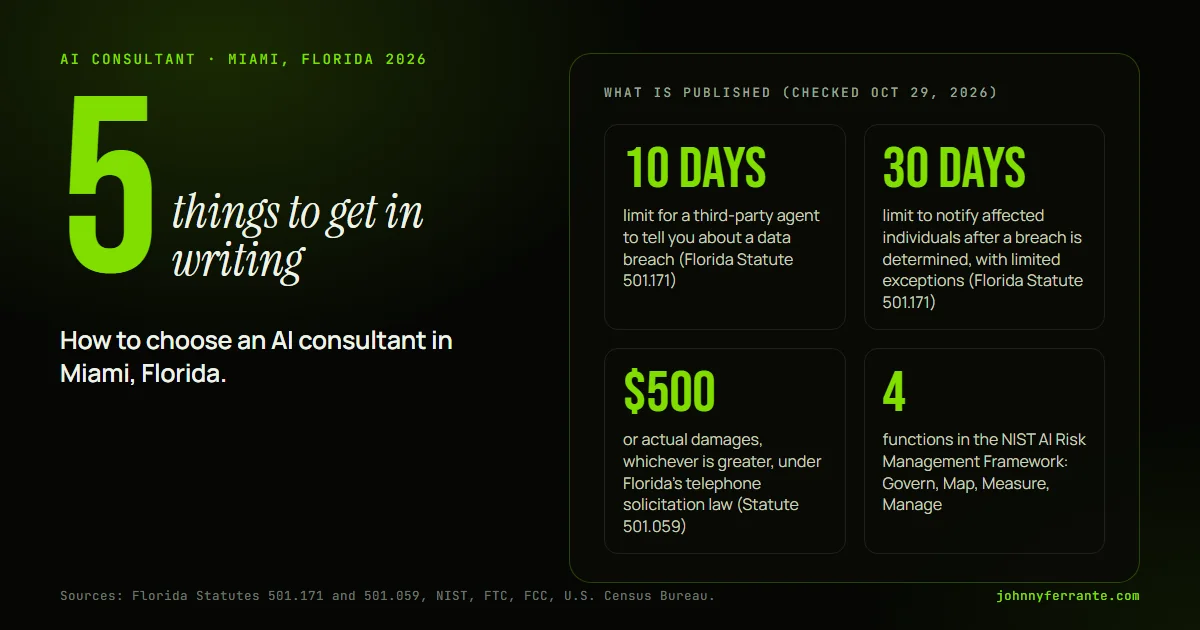
To choose an AI consultant in Miami, ask for five things in writing: a staged plan with dates, an itemized budget that separates tools from labor, a similar past project you can verify with a reference, a statement that you own your data, accounts and the finished system, and a plan for testing and monitoring after launch. If a consultant cannot provide them, keep looking.
Updated October 29, 2026.
Disclosure: I also run an AI agents company in Miami (Tech Agents), so I have a stake in this topic. Use this checklist on me too.
What does an AI consultant actually do?
A good AI consultant finds which of your processes are worth automating, picks the tools, builds or configures the solution, tests it with your team, trains your people, and documents everything so you can run it without them. In my view: someone who sells you one tool without first studying your process is a reseller, not a consultant. Two facts explain why a checklist matters. The Census Bureau's Business Trends and Outlook Survey found that overall AI use among U.S. businesses hovered between 17% and 20% from December 2025 to May 2026, and that less than 20% of firms with four or fewer employees reported using AI. In my view: that suggests many small businesses are new at this and may find it hard to judge a pitch. And in Miami-Dade County, 75.7% of people speak a language other than English at home (American Community Survey 2024 1-year estimate, via the Census Reporter profile). In my view: ask any consultant to show tests in Spanish as well as English.
What should you ask in the first meeting?
- What problem will this solve, and what number will prove it? Listen for a baseline you can measure (response time, bookings, hours saved), not "efficiency."
- Can you show a similar project, and can I talk to someone who used it? Ask what changed and how it was measured.
- Who does the work, and who answers when something breaks? Get names and response expectations.
- What can go wrong in my project? A real answer names wrong AI answers, consent rules for outbound messages, exposure of customer data, and tools that change price or policy.
- What happens if the AI model or a tool I depend on changes or disappears? Ask whether switching is a configuration change or a rebuild.
- What will I own when the project ends? The rest of this guide covers that.
What deliverables should you demand?
| Deliverable | Why it matters |
|---|---|
| Written scope and staged plan with dates | You can tell whether each stage was delivered |
| Itemized budget: tools, labor, training, support | You can verify tool costs yourself and compare quotes for the same scope |
| Test plan and results, in English and Spanish | Proof it works with your data before customers see it |
| Documentation: instructions, workflows, integrations | Someone else can run or change it later |
| Admin access to every account | You are not locked out of your own system |
| Data handling summary | You know what goes to which vendor, how long it is kept, and who can see it |
| Training session and a "how to pause it" runbook | Your team can stop it fast if it misbehaves |
| Monitoring and review plan after launch | Problems are caught by process, not by angry customers |
What should you own when the project ends?
Put this in the contract, in plain words:
- Accounts. Your messaging number, calendar, CRM, AI provider and any API keys should be registered to your business, not to the consultant.
- Data. Chat logs, leads and customer records belong to you. Ask in writing whether any vendor may use them to train models.
- The system. Instructions, workflows, code and documentation should be handed over, with the right to change them or move to another provider.
On intellectual property, the U.S. Copyright Office's January 2025 report Copyright and Artificial Intelligence, Part 2: Copyrightability "addresses the copyrightability of works created using generative AI." In my view: do not assume AI-generated material is protected the way human-made work is. Ask an attorney how ownership and assignment should be written for your project.
Customer data also has a Florida angle. Florida Statute 501.171 says each covered entity, governmental entity or third-party agent "shall take reasonable measures to protect and secure data in electronic form containing personal information." A third-party agent must notify the covered entity of a breach "as expeditiously as practicable, but no later than 10 days following the determination of the breach of security or reason to believe the breach occurred." The covered entity must notify affected individuals "no later than 30 days after the determination of a breach or reason to believe a breach occurred unless subject to a delay authorized under paragraph (b) or waiver under paragraph (c)." Those two paragraphs let law enforcement request a delay when notice would interfere with a criminal investigation, and let a covered entity skip individual notice when, after investigation, it reasonably determines the breach has not and will not likely result in identity theft or any other financial harm. The statute also says an agent's failure to provide proper notice is deemed a violation against the covered entity. So your contract should say who notifies whom, and how fast. This is not legal advice, and whether you are a "covered entity" is a question for an attorney.
Which red flags should make you walk away?
| Red flag | Why it matters |
|---|---|
| Results, rankings or income promised as a sure thing | Nobody controls your market. In September 2024 the FTC announced a crackdown on deceptive AI claims and schemes; Lina M. Khan, FTC Chair at the time, said "there is no AI exemption from the laws on the books." |
| One lump-sum number with no breakdown | You cannot compare quotes or see what is tool cost and what is labor |
| "It runs by itself, no people needed" | Agents need testing, limits and human review |
| Accounts or data held in the consultant's name | You cannot leave without losing your system |
| No answer on consent for outbound texts or calls | Consent rules carry real penalties (see below) |
| Demos only with generic examples | A demo on your own content, in both languages, shows what you will get |
| Cannot name what could go wrong | They have not worked through real projects |
Which rules should your consultant be able to explain?
You do not need your consultant to be your lawyer, but they should know these exist and point you to an attorney:
- FCC and the TCPA. On February 8, 2024 the FCC announced a Declaratory Ruling recognizing that calls made with AI-generated voices are "artificial" under the Telephone Consumer Protection Act. Its news release says the ruling "ensures AI-generated voices in calls are also held to those same standards" as the prior express written consent rule.
- Florida telephone solicitation law. Section 501.059 covers "telephone call, text message, or voicemail transmission" used to solicit sales, requires "prior express written consent" for unsolicited calls using automated dialing or recorded messages, and lets an aggrieved party recover "actual damages or $500, whichever is greater."
- WhatsApp. The messaging policy (last updated September 23, 2026) says you may contact people only if they gave you their number or username and you have opt-in permission.
How do you lower the risk of a first project?
Start small: a diagnostic, then a pilot on one process, then testing with your team, and only then expansion. The National Institute of Standards and Technology publishes the AI Risk Management Framework, released January 26, 2023 and "intended for voluntary use." Its four functions are Govern, Map, Measure and Manage. In my view: a practical way to use it is to ask four plain questions. Who is accountable (Govern)? What is the system for and where can it fail (Map)? How will it be tested (Measure)? What happens when something goes wrong (Manage)?
If you read Spanish, a similar guide written for Bolivia is in Cómo elegir un consultor de inteligencia artificial en Bolivia, and the difference between agents and chatbots is in Agents vs chatbots (in Spanish).
Frequently asked questions
How much does an AI consultant in Miami cost?
I could not find an official source with a standard rate, so I will not quote one. Ask for itemized quotes for the same scope and compare tool costs, labor, training and support line by line.
Do I need a consultant based in Miami?
In my view: local helps with time zone and with the English and Spanish mix of South Florida, but location matters less than the checklist above. Remote or local, ask for the same deliverables.
Can I do this myself?
For low-risk tasks such as drafting emails or summarizing documents, often yes. Consider help when AI touches customer messages, your calendar or CRM, or personal data.
How long does a first project take?
It depends on scope and on how fast you can provide information and review tests. Ask for a staged plan with dates and a test at each stage.
What customer data should never go into a public AI tool?
In my view: personal information, payment details and anything covered by confidentiality. Ask your consultant which tools are approved, and get their data handling in writing.
Who is writing this
Johnny Ferrante, founder of Quimera Group (Bolivia) and Tech Agents (Miami), and one of the five speakers at the SKÅL 2026 forum in Cochabamba, Bolivia. He is an expert in artificial intelligence and AI agents. Tech Agents describes itself on techagents.dev as "Custom-engineered AI agents for teams and operations." More about him in his press kit.
If you want to use this checklist with me as the example, book the 20-minute Diagnostic: you tell me where you are and you leave knowing what system you need and what you should not buy.
Sources
All pages below were opened on October 29, 2026.
- FTC, "FTC Announces Crackdown on Deceptive AI Claims and Schemes" (September 25, 2024): ftc.gov
- NIST, AI Risk Management Framework: nist.gov
- Florida Statutes, section 501.171: leg.state.fl.us
- Florida Statutes, section 501.059: leg.state.fl.us
- FCC news release, "FCC Makes AI-Generated Voices in Robocalls Illegal" (February 8, 2024): docs.fcc.gov
- U.S. Copyright Office, "Copyright and Artificial Intelligence, Part 2: Copyrightability" (January 2025): copyright.gov
- WhatsApp Business messaging policy (updated September 23, 2026): whatsappbusiness.com
- U.S. Census Bureau, "Large Firms With at Least 20 Employees Biggest AI Users" (May 26, 2026): census.gov
- U.S. Census Bureau, American Community Survey 2024 1-year estimates for Miami-Dade County, via Census Reporter: censusreporter.org
- Tech Agents, official site: techagents.dev
Want this running in your business?
See how we work, or join the community for free and ask about whatever is holding you back.
Keep reading
AI Automation for Small Business in Florida: What to Automate First
What a Florida small business should automate first: six concrete automations, public tool prices, Florida data-breach duties and how to measure results.
Bilingual AI Customer Service for Small Business: English and Spanish in the U.S.
Serve English and Spanish speakers with an AI assistant: language detection, handoff to a bilingual person, consent rules and metrics, with sources.
AI Agents for Small Business in Miami: A Practical Guide
A plain-English guide to AI agents for small business in Miami: agent vs chatbot, bilingual replies, booking and lead follow-up, risks, and how to measure.
In this guide
- What does an AI consultant actually do?
- What should you ask in the first meeting?
- What deliverables should you demand?
- What should you own when the project ends?
- Which red flags should make you walk away?
- Which rules should your consultant be able to explain?
- How do you lower the risk of a first project?
- Frequently asked questions
- How much does an AI consultant in Miami cost?
- Do I need a consultant based in Miami?
- Can I do this myself?
- How long does a first project take?
- What customer data should never go into a public AI tool?
- Who is writing this
- Sources