Bilingual AI Customer Service for Small Business: English and Spanish in the U.S.
Serve English and Spanish speakers with an AI assistant: language detection, handoff to a bilingual person, consent rules and metrics, with sources.
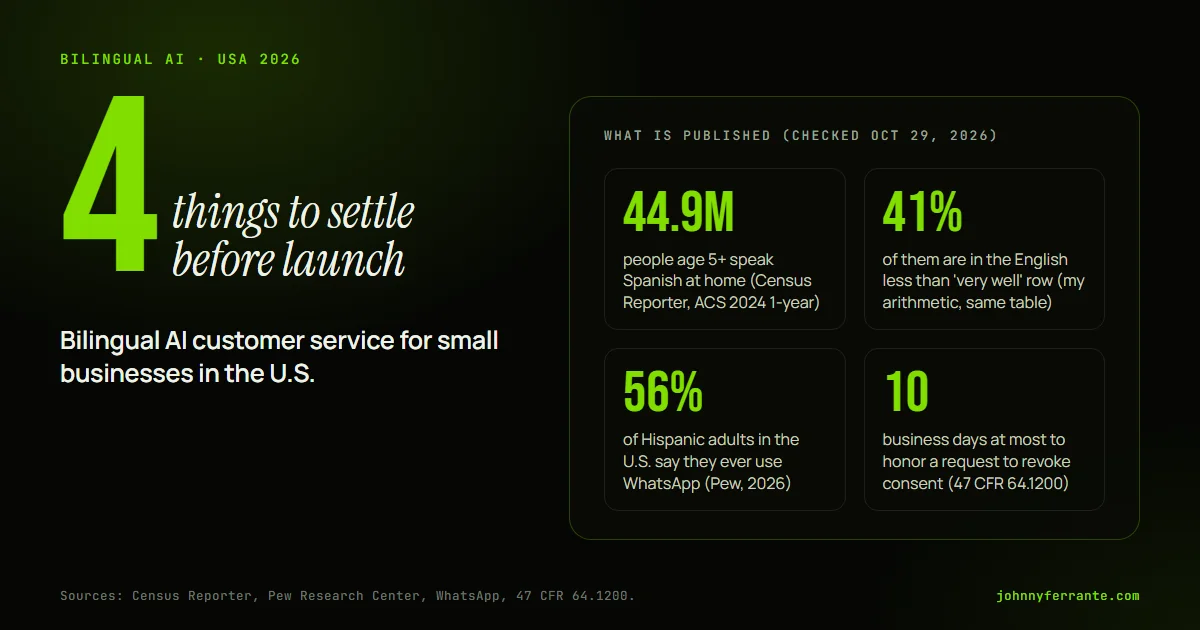
Bilingual AI customer service for a small business is an AI assistant that answers in English or Spanish, matching the language each customer writes in, and passes the chat to a bilingual person when the topic is sensitive or the customer asks for one. In the American Community Survey's 2024 1-year estimates, as shown by Census Reporter, 44,867,700 people age 5 and over speak Spanish at home. Before launch, settle four things: how the assistant detects language, when a person takes over, what it must never handle, and what consent you hold for messages you send first.
Updated October 29, 2026.
How many people in the U.S. speak Spanish at home?
Census Reporter shows American Community Survey (ACS) data. Its 2024 1-year table "Language Spoken at Home by Ability to Speak English for the Population 5 Years and Over" gives these counts for the United States (Spanish at home: about 44.9 million):
| People age 5 and over | Count | Margin of error |
|---|---|---|
| All | 321,745,950 | ±18,702 |
| Speak Spanish at home | 44,867,700 | ±143,192 |
| Spanish at home, speak English "very well" | 26,435,478 | ±117,269 |
| Spanish at home, speak English less than "very well" | 18,432,220 | ±123,301 |
Census Reporter's U.S. profile page also shows 23% ±0.1% (74,050,850 people) with a language other than English spoken at home. My arithmetic from the table: people who speak Spanish at home are 13.9% of everyone age 5 and over, and about 41% of them are in the row Speak English less than "very well".
Pew Research Center's social media fact sheet, published October 19, 2026, reports that 56% of Hispanic adults say they ever use WhatsApp, against 24% of White adults. It surveyed 5,511 U.S. adults from January 30 to June 18, 2026, with a margin of error of plus or minus 1.8 percentage points for the full sample.
In my view: neither figure says which language a customer wants from your business. Ask, remember the answer and let people switch.
How should the assistant detect which language to use?
In my view, keep detection simple and visible:
- Answer in the language of the customer's latest message, not the first one. People switch mid-chat.
- If a message is too short or mixed to tell, such as "ok" or a name, keep the current language. If you cannot tell at all, ask once: "English or español?"
- Do not guess from a name, an area code or a country code.
- Save the language once the customer confirms it, and let them change it with one word at any time.
- Test with real messages from your own chat history, including typos, missing accents and mixed English and Spanish.
When should a bilingual person take over the chat?
WhatsApp's Business Messaging Policy (last updated September 23, 2026) allows automation with a condition: "You may use automation when responding during the 24-hour window, but must also have available prompt, clear, and direct escalation paths." It lists six, including in-chat human agent transfer, a phone number, email and a support form. A person in the chat is one acceptable path, not the only one.
In my view, hand off when:
- the customer asks for a person, in either language ("agent," "human," "persona," "humano");
- there is a complaint, a refund, a billing dispute or a cancellation;
- the assistant misses the same question twice;
- the topic is medical, legal, tax or immigration, or you have no approved answer.
In my view, pass the language and a two-line summary with the handoff, so nobody makes the customer repeat themselves. Say who will answer and when. After hours, say so and offer a written path, not silence.
What tone works in English and Spanish?
In my view, aim for your front desk, not a translated manual:
- Same facts in both languages. Prices, hours and policies must mean the same thing in English and in Spanish.
- One form of address. In Spanish, pick usted or tú for your brand, stay consistent and follow the customer's lead.
- A native reviewer. Have a Spanish speaker from your customer base read every script and a sample of live replies, because vocabulary varies by region.
- Say it is automated. Tell customers, in their language, that they are chatting with an assistant and how to reach a person.
What should you not automate?
In my view, keep a person on these:
- refunds, complaints, billing disputes and price exceptions;
- medical, legal, tax and immigration questions;
- anything that needs a full card number, a financial account number or an ID number. WhatsApp's policy tells businesses not to share or ask people to share "full length individual payment card numbers, financial account numbers, personal ID card numbers, or other sensitive identifiers." Have a person move that step to another channel.
Write the list in both languages, put it in the assistant's instructions, then test it: ask each forbidden question in English and in Spanish, and confirm both hand off. A guardrail you only tested in English is an English guardrail.
What consent do you need before you message customers?
WhatsApp's policy says: "You may only contact people on WhatsApp if: (a) they have given you their mobile phone number or username; and (b) you have received opt-in permission from the recipient confirming that they wish to receive subsequent messages or calls from you." It also says you must respect any request, on or off WhatsApp, to block, discontinue or opt out of your messages.
U.S. law adds a second layer. 47 CFR 64.1200, the FCC rule that implements the Telephone Consumer Protection Act (TCPA), requires "prior express written consent of the called party" in paragraph (a)(2) for autodialed or prerecorded calls that include or introduce an advertisement or constitute telemarketing, when they go to cellular numbers or the other lines listed in (a)(1)(i) through (iii). Narrow exceptions exist, such as calls by tax-exempt nonprofits and certain health care messages. Paragraph (f)(9) defines that consent as "an agreement, in writing, bearing the signature of the person called" and counts an electronic signature to the extent federal law or state contract law recognizes it. Paragraph (a)(10) lets people revoke consent by "any reasonable method to clearly express a desire not to receive further calls or text messages" and treats a reply to a text using "stop," "quit," "end," "revoke," "opt out," "cancel," or "unsubscribe" as a reasonable means per se. Requests must be honored within a reasonable time, never more than 10 business days.
This is not legal advice. The rule's text speaks of calls and text messages, and whether it covers your WhatsApp messages is a legal question. Consult an attorney before you send marketing messages, and have them review your opt-in wording in both languages.
In my view: show the opt-in wording in the language of the chat, and record the wording, language, date and number. The words the rule lists are English, but its test is any reasonable method, so treat "parar," "cancelar" and "ya no quiero mensajes" as opt-outs too.
Which metrics show whether bilingual service works?
In my view, split every number by language and compare Spanish with English line by line.
| Metric | What it tells you |
|---|---|
| Chats | Whether Spanish demand matches your customer list |
| Resolved without a person | Whether the assistant is as good in Spanish as in English |
| Handoffs and their reasons | Which topics and scripts fail |
| Minutes to first human reply after a handoff | Whether bilingual coverage is enough |
| Opt-outs, blocks and reports | Whether people want the messages |
| Wrong-language replies in a weekly sample | Whether detection works |
WhatsApp's policy says its systems may limit how many messages a business can send based on user feedback, so blocks and reports belong on the dashboard.
Frequently asked questions
Does a customer who speaks Spanish at home want Spanish from you?
The data cannot say. Of the 44,867,700 people who speak Spanish at home, 26,435,478 are in the row labeled Speak English "very well" in the Census Reporter table. In my view, home language is a signal, not a preference, so ask.
Can the assistant send the first message in Spanish?
Only to people who opted in, and outside the 24-hour window only with an approved message template. This article does not cover how templates are approved in each language, so ask your provider how Spanish and English versions get approved. For channel basics, see WhatsApp AI agents for U.S. businesses with Latino customers.
What if nobody on my team speaks Spanish?
In my view: say so, and do not promise a Spanish-speaking person you cannot staff. Offer a written path such as email or a form, tell the customer when a reply will come, and have an outside Spanish speaker review the assistant's scripts before launch.
What does Meta charge for service messages?
Each business phone number gets 1,000 free service messages a month, and Meta charges from the 1,001st, effective October 1, 2026. Without a payment method on the account, Meta delivers service messages within the free tier but not after it. For rates by category, see WhatsApp Business API pricing in the United States.
Who is writing this
Johnny Ferrante, founder of Quimera Group (Bolivia) and Tech Agents (Miami), and one of the five speakers at the SKÅL 2026 forum in Cochabamba. Press page: johnnyferrante.com/prensa. Related guides: AI agents for small business in Miami and how to choose an AI consultant in Miami, Florida.
Next step: the 20-minute Diagnostic. You tell me where your business is today, and you leave knowing which system you need and which ones are not worth buying.
Sources
Opened October 29, 2026.
- Census Reporter, United States profile (ACS 2024 1-year): censusreporter.org
- Census Reporter API, table B16001 (ACS 2024 1-year): api.censusreporter.org
- Pew Research Center, Social Media Fact Sheet (published October 19, 2026): pewresearch.org
- Meta, WhatsApp Business Platform pricing: developers.facebook.com
- WhatsApp Business Messaging Policy (last updated September 23, 2026): whatsappbusiness.com
- 47 CFR 64.1200, FCC rule under the TCPA, text on Cornell Law School's Legal Information Institute: law.cornell.edu
Want this running in your business?
See how we work, or join the community for free and ask about whatever is holding you back.
Keep reading
AI Automation for Small Business in Florida: What to Automate First
What a Florida small business should automate first: six concrete automations, public tool prices, Florida data-breach duties and how to measure results.
AI Agents for Small Business in Miami: A Practical Guide
A plain-English guide to AI agents for small business in Miami: agent vs chatbot, bilingual replies, booking and lead follow-up, risks, and how to measure.
How to Choose an AI Consultant in Miami, Florida (2026)
How to choose an AI consultant in Miami, Florida: questions to ask, red flags, deliverables to demand, and what you should own when the project ends.
In this guide
- How many people in the U.S. speak Spanish at home?
- How should the assistant detect which language to use?
- When should a bilingual person take over the chat?
- What tone works in English and Spanish?
- What should you not automate?
- What consent do you need before you message customers?
- Which metrics show whether bilingual service works?
- Frequently asked questions
- Does a customer who speaks Spanish at home want Spanish from you?
- Can the assistant send the first message in Spanish?
- What if nobody on my team speaks Spanish?
- What does Meta charge for service messages?
- Who is writing this
- Sources