AI Automation for Small Business in Florida: What to Automate First
What a Florida small business should automate first: six concrete automations, public tool prices, Florida data-breach duties and how to measure results.
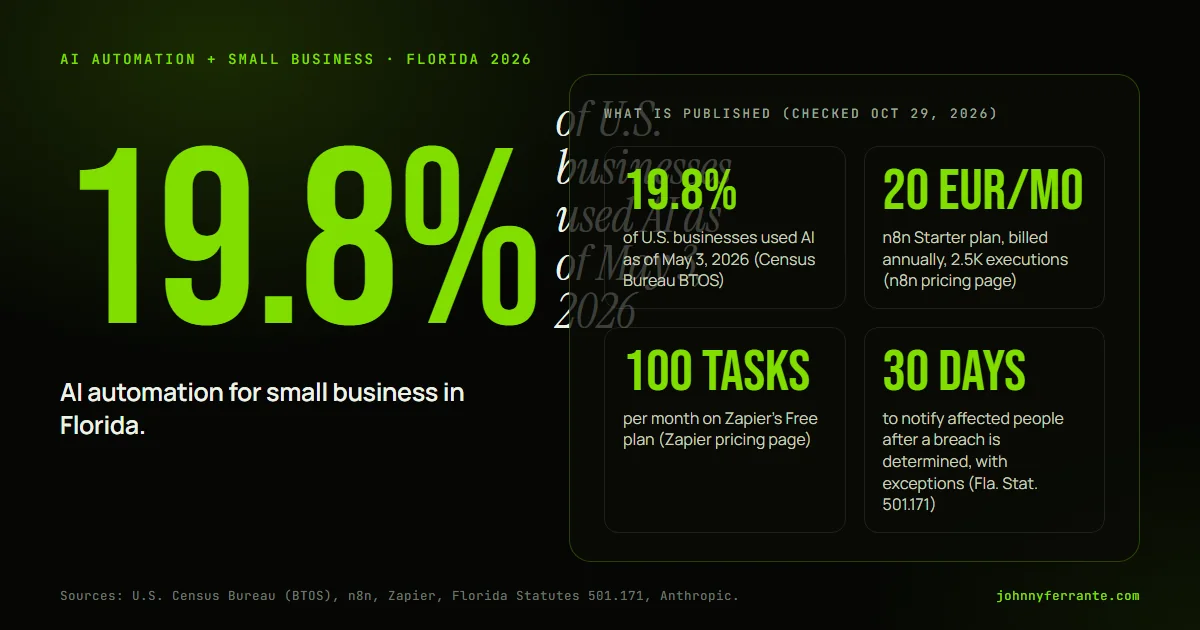
Start with work that repeats every week, follows clear rules and costs little if the software gets it wrong: appointment reminders, lead capture, invoice follow-ups, review requests, inbox sorting and a weekly report. Automate one, measure it for four weeks, and keep a person in charge of refunds, complaints and sensitive customer data.
Updated October 29, 2026.
What should a small business automate first?
My rule of thumb: pick tasks that repeat on a schedule or trigger, follow rules you could write on one page, and are cheap to get wrong because a person can catch the mistake in minutes. A reminder with the wrong arrival time is annoying; a wrong refund is expensive.
Anthropic's guide Building effective agents (December 19, 2024) puts the same idea in software terms: "we recommend finding the simplest solution possible, and only increasing complexity when needed," and "workflows offer predictability and consistency for well-defined tasks." The page itself notes that much of the tooling it describes has changed since December 2024; in my view, read it for principles, not tools.
In my view: most first automations are workflows with fixed steps that use an AI model only where language is needed, such as sorting a message. Leave agents, where the model decides what to do next, for later; my guide to AI agents for small business in Miami explains what an AI agent is.
Are small businesses already using AI?
Some are, but the national figure covers businesses of all sizes: about one in five U.S. businesses, according to the Census Bureau. Its Business Trends and Outlook Survey (BTOS) asks whether a business used AI in the past two weeks. A May 26, 2026 Census Bureau story says that from December 2025 to May 2026 "overall AI usage hovered between 17% and 20%." As of May 3, 2026, the national rate was 19.8%. By size, 37% of firms with at least 250 employees reported using AI, while "Less than 20% of firms with four or fewer employees reported using AI." Over those months, use rose among firms with at least 20 employees but did not change significantly among firms with fewer than 20. These are national figures, not Florida figures.
Which six automations are worth trying first?
These six are my picks, not a ranking from a study, and each has a clear trigger and a person who can step in.
- Appointment reminders. When a booking lands in your calendar, send a confirmation and a reminder with the time, address and a way to reschedule. A mistake costs one phone call.
- Lead capture. When a web form or ad lead arrives, add it to your CRM or spreadsheet, alert the right person and send a first reply. An AI step can sort the request; a person takes over.
- Invoice follow-ups. When an invoice is overdue, draft a polite reminder for a person to approve. Switch to automatic sending only after you have read a month of drafts.
- Review requests. When a job is marked complete, send one message with your review link. In my view: ask every customer the same way, offer no rewards, and read each platform's own rules.
- Inbox sorting. An AI step labels each new email or form message (quote, scheduling, billing, other), drafts a reply and routes it. A person sends anything about money or a complaint.
- Weekly summary. Every Monday, pull leads, bookings and unpaid invoices from your tools and email the owner a plain summary. It reads data and emails one person, so I rate the risk low.
Do not start with refunds, price exceptions, complaints or anything resembling legal, medical or financial advice. If your customers write on WhatsApp, see WhatsApp AI agents for U.S. businesses with Latino customers and WhatsApp Business API pricing in the United States.
Which tools have public pricing, and what do they cost?
Two automation platforms publish their prices. Check them again before you budget.
n8n showed euros when I opened it. It defines its unit this way: "An execution is a single run of your entire workflow." With annual billing it lists Starter at €20 per month (2.5K executions, 1 shared project), Pro at €50 (10K executions, 3 shared projects) and Business at €667 (40K executions, 6 shared projects; the page labels Business "Self-hosted only"). It also lists a self-hosted Community Edition on GitHub.
Zapier had "Pay yearly (Save 33%)" selected by default. Its Free plan is $0 per month and lists "Zaps, Tables, and Forms included (100 tasks per month)." With that default, Professional shows "Starting from $19.99 /month" and Team "Starting from $69 /month." Free lists two-step Zaps; Professional lists multi-step Zaps.
In my view: the software fee is usually the smallest cost; add setup time, the weekly review and repairs when an app changes. Self-hosting n8n means you run and secure the server yourself. If a step calls an AI model, ask whether that usage is billed separately.
What are your data-breach duties in Florida?
If an automation touches customer data, Florida's data breach law, section 501.171 of the Florida Statutes, may apply to your business and to the vendors you connect. A small business can be a "covered entity," which includes any sole proprietorship, partnership or corporation that acquires, maintains, stores, or uses personal information. Its history line ends with chapter 2026-52, so a 2026 law amended it. In my view: read the statute, not an older summary.
- Duty to protect. "Each covered entity, governmental entity, or third-party agent shall take reasonable measures to protect and secure data in electronic form containing personal information."
- What counts. A defined list, such as a name combined with a Social Security number, a driver license number, a financial account or card number with its access code, or medical information, or a user name or email address with a password. See subsection (1)(g) for the full list and exclusions.
- Notice. A breach affecting 500 or more individuals in Florida goes to the Department of Legal Affairs "no later than 30 days after the determination of the breach or reason to believe a breach occurred." Affected individuals must be told "as expeditiously as practicable and without unreasonable delay," and within the same 30 days unless an extension, delay or waiver in the statute applies.
- Vendors. A third-party agent is an entity contracted to maintain, store or process personal information for a covered entity. If a breach hits a system it maintains, it must notify the covered entity "no later than 10 days following the determination of the breach of security."
- Penalties. Failing to give the required notices carries civil penalties of $1,000 for each day for the first 30 days, then $50,000 for each subsequent 30-day period for up to 180 days, "not to exceed $500,000," applied per breach, not per individual.
This is information, not legal advice. A Florida attorney can tell you whether the statute applies to you, which of your tools count as third-party agents and what your breach plan should say.
In my view: keep the items on that list out of automation tools and AI prompts unless you need them, list every tool that touches customer data and who can log in, and ask each vendor in writing how fast it would report a breach. Treat any promise of zero risk as a red flag.
How do you measure whether an automation works?
Track the task by hand for two to four weeks, run the automation for four weeks, then compare. Outcomes differ by business, and no one can promise yours.
| Automation | What to count |
|---|---|
| Reminders | Missed appointments divided by bookings |
| Lead capture | Minutes from form to first reply |
| Invoice follow-ups | Average days to payment |
| Review requests | Reviews received per requests sent |
| Inbox sorting | Share labeled correctly in a weekly sample |
| Weekly summary | Hours you used to spend on the report |
In my view: the real test is money and time. Multiply the hours saved each month by the hourly cost of whoever did the work, then subtract the tool fee and your maintenance hours. Decide before launch which error rate means you switch it off.
Frequently asked questions
Is AI automation the same as an AI agent?
No. In Anthropic's words, workflows are "orchestrated through predefined code paths," while agents "dynamically direct their own processes and tool usage." In my view, most small business automations are workflows.
Do I need a developer?
In my view: a careful owner can build simple flows, such as reminders or a weekly summary, in a visual workflow tool. Bring in a technical person for payments, health information or customer logins, and keep every account in your business's name. See how to choose an AI consultant in Miami, Florida.
Do I have to tell customers if their data is exposed?
Section 501.171 sets a 30-day deadline to notify affected individuals after a breach is determined or there is reason to believe one occurred, subject to exceptions. Whether it applies to you depends on your facts, so ask a Florida attorney.
Can I text or call customers first with automation?
Replying to a customer who wrote to you is different from texting or calling people first. My Miami guide lists three official sources on consent for outbound contact. Have an attorney review any outbound campaign before it goes live.
Who is writing this
Johnny Ferrante is the founder of Quimera Group (Bolivia) and Tech Agents (Miami), and one of the five speakers at the SKÅL 2026 forum in Cochabamba, Bolivia. He is an expert in artificial intelligence and AI agents. His press kit has the details.
To find out which system you need and which one you should not buy, book the 20-minute Diagnostic. You tell me where your business stands and leave knowing both.
Sources
I opened every page below on October 29, 2026.
- U.S. Census Bureau, "Large Firms With at Least 20 Employees Biggest AI Users" (Business Trends and Outlook Survey, May 26, 2026): census.gov
- n8n, pricing page: n8n.io
- Zapier, pricing page: zapier.com
- Florida Statutes, section 501.171, "Security of confidential personal information": leg.state.fl.us
- Anthropic, "Building effective agents" (December 19, 2024): anthropic.com
Want this running in your business?
See how we work, or join the community for free and ask about whatever is holding you back.
Keep reading
Bilingual AI Customer Service for Small Business: English and Spanish in the U.S.
Serve English and Spanish speakers with an AI assistant: language detection, handoff to a bilingual person, consent rules and metrics, with sources.
AI Agents for Small Business in Miami: A Practical Guide
A plain-English guide to AI agents for small business in Miami: agent vs chatbot, bilingual replies, booking and lead follow-up, risks, and how to measure.
How to Choose an AI Consultant in Miami, Florida (2026)
How to choose an AI consultant in Miami, Florida: questions to ask, red flags, deliverables to demand, and what you should own when the project ends.
In this guide
- What should a small business automate first?
- Are small businesses already using AI?
- Which six automations are worth trying first?
- Which tools have public pricing, and what do they cost?
- What are your data-breach duties in Florida?
- How do you measure whether an automation works?
- Frequently asked questions
- Is AI automation the same as an AI agent?
- Do I need a developer?
- Do I have to tell customers if their data is exposed?
- Can I text or call customers first with automation?
- Who is writing this
- Sources