WhatsApp AI Agent for Business in the United States: A Guide for Companies with Latino Customers
How a WhatsApp AI agent works for U.S. businesses with Latino customers: Pew data, Meta pricing since Oct 1, 2026, opt-in rules and limits, with sources.
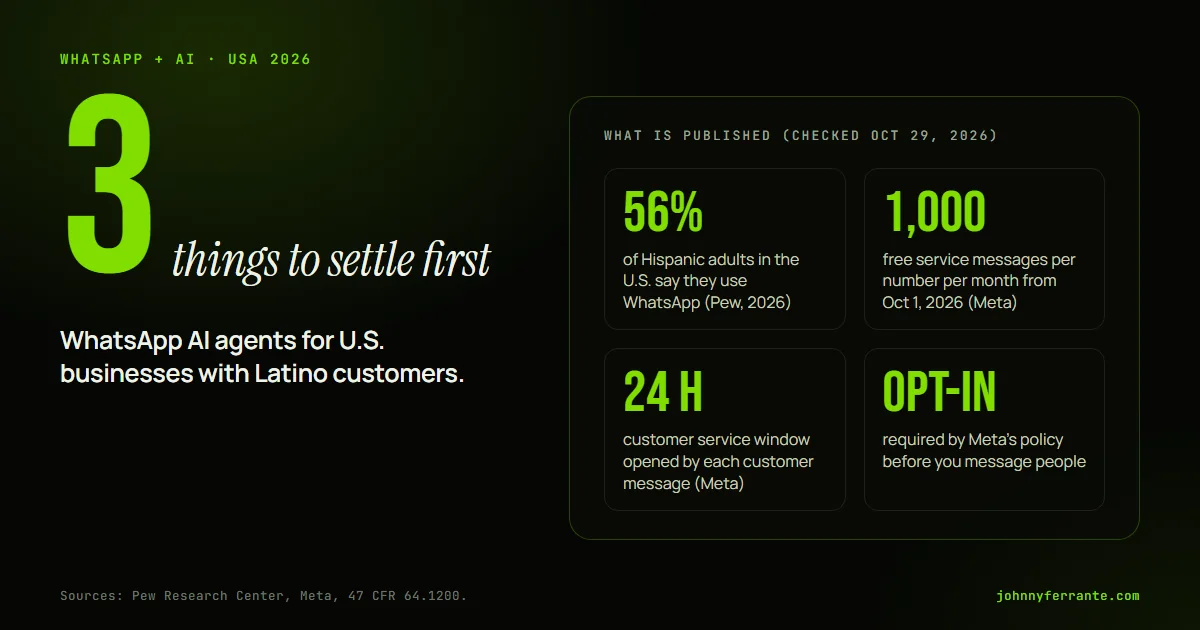
A WhatsApp AI agent is software that answers your customers' messages on WhatsApp and hands the conversation to a person when needed. In the United States it makes sense when your customers already use the app: Pew Research Center reports that 56% of Hispanic adults say they use WhatsApp, against 24% of White adults. Before you build one, settle three things: Meta's WhatsApp Business Platform rather than only the free app, documented permission from the people you message, and a budget for Meta's per-message pricing, which changed on October 1, 2026.
Updated October 29, 2026.
How many Hispanic and Latino customers in the U.S. use WhatsApp?
Pew Research Center's social media fact sheet (it uses the term Hispanic), published October 19, 2026, reports the share of U.S. adults who say they ever use each platform. For WhatsApp the figures are 56% of Hispanic adults, 51% of Asian adults (English speakers only), 40% of Black adults and 24% of White adults. The survey covered 5,511 U.S. adults from January 30 to June 18, 2026, with a margin of error of plus or minus 1.8 percentage points for the full sample. Margins of error for subgroups such as Hispanic adults are larger than that.
Among Hispanic adults, the same fact sheet shows:
| Platform | Hispanic adults who say they ever use it |
|---|---|
| YouTube | 85% |
| 70% | |
| 60% | |
| 56% | |
| TikTok | 53% |
In my view: the number measures who uses the app, not who wants to chat with your business there. Facebook (70%) and Instagram (60%) are used by even more Hispanic adults, so treat WhatsApp as one channel, not the only one. The figures do not say which language your customers prefer, so ask them and test the agent in Spanish, English and mixes of both.
WhatsApp Business app or Platform: which one does an AI agent need?
Meta runs two products. The WhatsApp Business app is "for small businesses to communicate with customers from a single device through a free-to-download app." The WhatsApp Business Platform "enables medium and large businesses to chat with customers at scale through programmatic access to WhatsApp." On the Platform you onboard through a Meta partner or connect directly with developers, and Meta's page describes approved templates, automated flows, AI tools and routing to a live agent when needed.
| Feature | Business app | Business Platform |
|---|---|---|
| Built for | Small businesses, one device | Medium and large businesses |
| Connection | Download the app | Partner signup or developers |
| Automation Meta describes | Greeting and away messages | Templates, flows, AI tools, live-agent routing |
| Cost model | Free to download | Per-message pricing |
In my view: if one person can answer your volume, the app may be enough. An agent that works around the clock and connects to your booking or order system belongs on the Platform, because that is where Meta describes automation and AI tools.
How does Meta charge for WhatsApp messages in 2026?
Since July 1, 2025, Meta charges per message delivered, with rates that vary by market and category: marketing, utility, authentication, service and Meta Business Agent (Meta's own AI agent). Three things changed or came into force on October 1, 2026:
- Service messages: your free-form replies inside the 24-hour window now include 1,000 free per business phone number each month, and Meta charges from the 1,001st. They had not been charged since November 1, 2024.
- Utility templates: those sent inside an open service window, free since July 1, 2025, are charged again.
- Payment method: without one on the account, Meta delivers service messages only within the free tier, so an agent can go silent after message 1,000. Meta's page also said that Solution Providers and directly integrated businesses with no payment method on file by September 30, 2026 would stop having service messages delivered.
For the U.S., Meta's rate cards (effective October 1, 2026) list a "North America" group of two markets, Canada and the United States, both +1. The USD figures are in Meta's interactive rate card and its CSV and PDF downloads. I could not verify them as plain text, so this guide quotes no U.S. rates: look up your categories there before you budget. Your AI model and any platform or developer fees are separate costs.
What permission do you need before you message people?
Meta's WhatsApp Business Messaging Policy (last updated September 23, 2026) says: "You may only contact people on WhatsApp if: (a) they have given you their mobile phone number or username; and (b) you have received opt-in permission from the recipient confirming that they wish to receive subsequent messages or calls from you." It adds that you must honor requests to block, stop or opt out, and that you are responsible for securing the notices, permissions and consents you need and for complying with applicable law.
U.S. law adds its own layer. Under the FCC's rule 47 CFR 64.1200, which implements the Telephone Consumer Protection Act (TCPA), calls that include an advertisement or constitute telemarketing, made with an automatic dialing system or an artificial or prerecorded voice to a wireless number, require "prior express written consent of the called party." That means a signed written agreement (an electronic signature can count) that authorizes the specific number and states that signing is not a condition of buying anything. The rule also treats words such as stop, quit, end, revoke, opt out, cancel and unsubscribe, sent in reply to a text message, as a reasonable way to revoke consent, and says revocation requests must be honored within a reasonable time not to exceed ten business days.
This is not legal advice. Those rules are written for calls and text messages to mobile numbers, and whether and how they apply to your WhatsApp messages is a legal question this guide cannot answer. Consult an attorney before you send marketing messages and have them review your opt-in wording. In my view: save the wording, date and number for every opt-in, make leaving easy, and treat a clear opt-out in Spanish or English as an opt-out.
What can an AI agent do on WhatsApp, and what can't it do?
What Meta's documentation supports:
- Free-form replies in an open window. Meta: "Non-template messages (service message or Meta Business Agent message) can only be sent in an open 24-hour customer service window, which opens and resets with each user message."
- A configurable agent. Meta Business Agent is described as an AI agent that "handles customer conversations 24/7 in your brand voice." You can add business information, FAQs, websites and files, connect APIs and webhooks for actions such as bookings, hand control to your own app, and test before going live.
Where it stops:
- No cold outreach. Outside the window you need an approved template, and only for people who opted in.
- Not every industry or country. Meta Business Agent excludes finance, government, health, alcohol, gambling, over-the-counter drugs and matrimony services, and requires an "eligible country." The overview page does not list the countries, so confirm in your Meta account that the U.S. qualifies.
- Not a general-purpose assistant product. Section 4.7 of Meta's Platform terms bars providers of AI technologies such as large language models and general-purpose AI assistants from using the Platform to offer them when that is the primary rather than an incidental or ancillary function, as Meta determines in its sole discretion. Meta's AI providers page says such providers may offer general-purpose assistants only where Meta is legally required to permit it, effective January 15, 2026. In my view: an agent that answers questions about your own business is a different thing, but Meta makes the call, so ask your provider how they comply.
- Not free use of chat data. That section also says Platform data cannot be used to create, develop, train or improve AI models, with an exception for fine-tuning a model for your exclusive use. Ask your attorney whether it applies to you before training on chat history.
In my view: keep a person in the loop for refunds, complaints, medical or legal questions and anything involving money, write down what the agent may say about prices and policies, and test it with real customer messages before launch.
Frequently asked questions
Is the WhatsApp Business app free?
Meta describes it as a free-to-download app for small businesses. The Platform, where Meta describes automation and AI tools, charges per message.
Can an AI agent message customers first?
Only with an approved template and only for people who opted in. Free-form messages go out only inside the 24-hour window that a customer's message opens.
What does Meta charge a U.S. business per message?
It depends on the category. Meta's rate cards, effective October 1, 2026, group the U.S. and Canada (+1) under North America; read the USD rates there. Service messages include 1,000 free per number per month.
Does Meta Business Agent work for U.S. businesses?
Meta requires an eligible country and does not list the countries on its overview page. Confirm in your Meta account before planning around it.
Does Pew's 56% mean Hispanic customers want to talk to a bot?
No. It measures who uses the app. Ask your own customers what they prefer, and keep a human option.
Who is writing this
Johnny Ferrante, founder of Quimera Group (Bolivia) and Tech Agents (Miami), and one of the five speakers at the SKÅL International Tourism Forum 2026 in Cochabamba. More at johnnyferrante.com/prensa. In Spanish, see agentes vs. chatbots.
To find out which setup fits your business, request the 20-minute Diagnostic: you tell me where you are and you leave knowing which system you need and what you should not buy.
Sources (checked October 29, 2026)
- Pew Research Center, Social Media Fact Sheet (published October 19, 2026): pewresearch.org
- Meta, WhatsApp Business Platform pricing: developers.facebook.com
- Meta, non-template messages: developers.facebook.com
- Meta, Meta Business Agent overview: developers.facebook.com
- Meta, AI providers on the WhatsApp Business Platform (last updated October 15, 2026): developers.facebook.com
- Meta, Terms for WhatsApp Business Platform (last updated September 23, 2026): facebook.com
- WhatsApp Business Messaging Policy (last updated September 23, 2026): whatsappbusiness.com
- WhatsApp Business, frequently asked questions: whatsappbusiness.com
- WhatsApp Business app: whatsappbusiness.com
- WhatsApp Business Platform: whatsappbusiness.com
- 47 CFR 64.1200, FCC rule implementing the TCPA (text published by Cornell Law School's Legal Information Institute): law.cornell.edu
Want this running in your business?
See how we work, or join the community for free and ask about whatever is holding you back.
Keep reading
AI Automation for Small Business in Florida: What to Automate First
What a Florida small business should automate first: six concrete automations, public tool prices, Florida data-breach duties and how to measure results.
Bilingual AI Customer Service for Small Business: English and Spanish in the U.S.
Serve English and Spanish speakers with an AI assistant: language detection, handoff to a bilingual person, consent rules and metrics, with sources.
AI Agents for Small Business in Miami: A Practical Guide
A plain-English guide to AI agents for small business in Miami: agent vs chatbot, bilingual replies, booking and lead follow-up, risks, and how to measure.
In this guide
- How many Hispanic and Latino customers in the U.S. use WhatsApp?
- WhatsApp Business app or Platform: which one does an AI agent need?
- How does Meta charge for WhatsApp messages in 2026?
- What permission do you need before you message people?
- What can an AI agent do on WhatsApp, and what can't it do?
- Frequently asked questions
- Is the WhatsApp Business app free?
- Can an AI agent message customers first?
- What does Meta charge a U.S. business per message?
- Does Meta Business Agent work for U.S. businesses?
- Does Pew's 56% mean Hispanic customers want to talk to a bot?
- Who is writing this
- Sources (checked October 29, 2026)